
Companion study · first-language comparison
Which English Sounds Are Hardest for Chinese TOEFL Learners?
Helen He, CEO, LingoLeap · September 2026
Quick answer
Across 6,057 sessions that set an interface language, Chinese-interface learners (4,904 sessions) and English-interface learners (1,045 sessions) score within 1.4 points of each other on almost every English sound. The one clear divergence is /θ/: it is the hardest sound for the Chinese-interface group (63.5/100), about 9 points below that group’s next-hardest sound — and it does not even reach the English-interface group’s ranked difficulty list.
The main study kept first language out of scope, because it is unavailable for most sessions. This page runs the one first-language cut the data can support: Chinese-interface versus English-interface learners.
We expected the boring, easily-misread result — “Chinese learners score lower overall.” The data says something more interesting: the two groups are almost identical everywhere, and diverge at exactly one sound. That near-parity is what makes the exception credible — it is not a by-product of general ability, but a specific, trainable target.
Methodology
Learners did not declare a first language. We use their chosen LingoLeap interface language as a proxy. Two consequences follow: interface language is not the same as native language, and only about 26% of learners set one (6,057 of 23,390 sessions). This page therefore describes that subset and does not represent all TOEFL learners or support population-level claims.
Otherwise the method matches the main study: each recording is scored by automatic pronunciation assessment (0–100 per phoneme), and word-final -s is recovered by aligning the target to the recognised words. A sound is ranked within a group only when it accumulates roughly 1,000+ measurements in that group; rarer sounds are left unranked. We report denominators, means, and group differences, but no significance tests — repeated learners and prompts are not independent observations.
- Sample
- 6,057 of 23,390 TOEFL 2026 Listen and Repeat sessions set a LingoLeap interface language: 4,904 Chinese-interface sessions (32,231 scored attempts) and 1,045 English-interface sessions (6,879 attempts). The number of distinct learners is not recorded.
- Period
- From 1 January 2026. The end of the extraction window is not recorded in this study's data file.
- Source
- A read-only, offline aggregation of LingoLeap practice records, joined to each learner's interface-language setting, which stands in for first language. Aggregates only: no recordings, transcripts, user IDs or individual attempts.
- How scores were produced
- Phoneme accuracy (0–100) comes from automatic speech pronunciation assessment; sentence scores (0–5) are LingoLeap AI platform scores. None of these are ETS scores.
- Exclusions
- The 17,333 sessions with no interface language are outside the comparison. A sound is ranked within a group only with roughly 1,000+ measurements in that group, so /θ/ is unranked for English-interface learners.
- Limitations
- Interface language is a proxy, not a declared first language, and covers only about 26% of sessions. Observational: no significance tests, and repeated learners and prompts are not independent. Pronunciation is judged by a machine, not a phonetician.
Pattern 1: The one sound that actually diverges is /θ/
/θ/ is the hardest sound for the Chinese-interface group at 63.5/100; for the English-interface group it does not rank as a difficulty at all.
Embed this chart
Paste this HTML into your page. It is a static image with a credit link: no script, no iframe.
<figure style="margin:0;max-width:660px">
  <img src="https://lingoleap.ai/research/charts/chinese-learners-phoneme-compare.svg" alt="Figure 1. Accuracy by sound, both groups" width="660" height="472" style="max-width:100%;height:auto" loading="lazy">
  <figcaption>Source: <a href="https://lingoleap.ai/research/chinese-learners-toefl-pronunciation">LingoLeap, Which English Sounds Are Hardest for Chinese TOEFL Learners?</a></figcaption>
</figure>
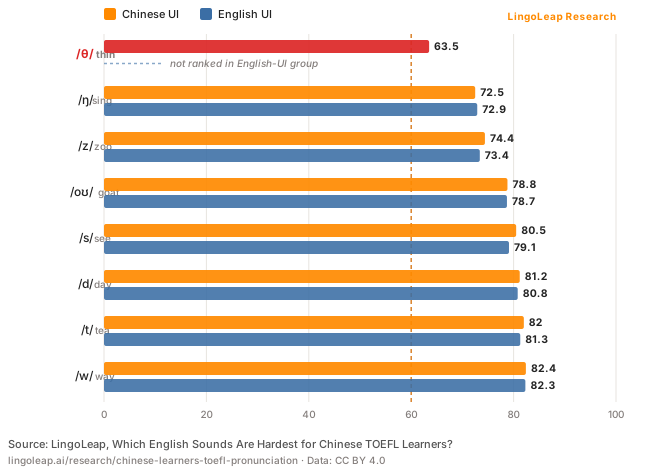
The size of the gap is worth pausing on. The Chinese group’s second-hardest sound, /ŋ/ (72.5), already sits about 9 points above /θ/. So /θ/ is not “one more slightly hard sound” — it is a single outlier, cleanly separated from the rest. Of its 3,252 measured occurrences, 36.0% fell below the 60-point threshold.
› Why this particular sound?
Mandarin and most Chinese varieties have no /θ/ in their inventory, and learners often substitute the nearest sounds, /s/ or /t/ — exactly the phoneme-specific variation cross-language speech research predicts [2]. That is a plausible reading of the pattern, not a substitution mechanism this page tested directly.
Pattern 2: Almost everything else is the same
This section is really the control for the last one. If the two groups differ only at /θ/ and match everywhere else, the /θ/ gap is more likely a real linguistic effect than an artefact of sampling or overall level.
| Sound | Chinese UI | English UI | Difference |
|---|---|---|---|
| /θ/ | 63.5 | unranked | — |
| /ŋ/ | 72.5 | 72.9 | -0.4 |
| /z/ | 74.4 | 73.4 | +1.0 |
| /oʊ/ | 78.8 | 78.7 | +0.1 |
| /s/ | 80.5 | 79.1 | +1.4 |
| /d/ | 81.2 | 80.8 | +0.4 |
| /t/ | 82 | 81.3 | +0.7 |
| /w/ | 82.4 | 82.3 | +0.1 |
Sentence length behaves almost identically too. Reproduction falls as sentences grow in both groups, and the curves nearly overlap — 79.5% vs 81.2% on the shortest sentences, 51.5% vs 53.2% on the longest.
Embed this chart
Paste this HTML into your page. It is a static image with a credit link: no script, no iframe.
<figure style="margin:0;max-width:660px">
  <img src="https://lingoleap.ai/research/charts/chinese-learners-sentence-length.svg" alt="Figure 2. Reproduction by sentence length, both groups" width="660" height="320" style="max-width:100%;height:auto" loading="lazy">
  <figcaption>Source: <a href="https://lingoleap.ai/research/chinese-learners-toefl-pronunciation">LingoLeap, Which English Sounds Are Hardest for Chinese TOEFL Learners?</a></figcaption>
</figure>
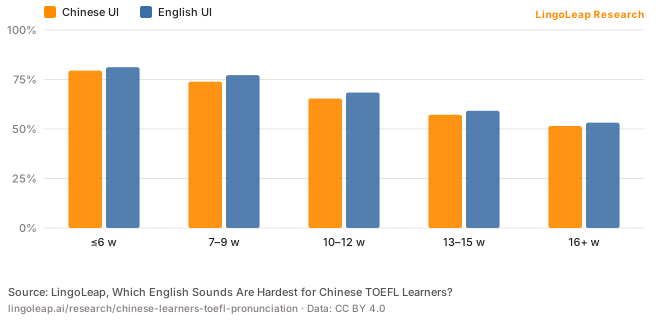
Word-final -s tells the same story: 10.7% dropped in the Chinese-interface group versus 9.6% in the English-interface group. Put together, the picture is clear — the two Listen and Repeat profiles largely overlap, and the one meaningful crack is at /θ/.
How to read this
The largest group — learners who set no interface language — also ranks /θ/ hardest, at about 61, matching the Chinese-interface group. Given LingoLeap’s heavily Chinese-speaking user base, that is consistent with the unset group being largely Chinese-first-language. It corroborates the pattern but is not independent confirmation.
For a Chinese-first-language test-taker, this narrows a vague worry (“my pronunciation isn’t good enough”) into a concrete target: /θ/ is worth isolating and prioritising, while on most other sounds your gap to English-interface learners is small. It also argues for targeting the few sounds that actually diverge by first language, rather than “practising pronunciation” in general.
What this study cannot show
- Interface language is a proxy for, not the same as, first language; it cannot separate heritage speakers, bilinguals, and similar cases.
- Limited coverage: only about 26% of learners set a UI language, and the English-interface group has just 1,045 sessions — a much smaller sample than the Chinese group.
- /θ/ is unranked for the English-interface group because its measurement count fell below the threshold, so we say only that it does not enter the difficulty ranking — not that it is easy for English-interface learners.
- These are automatic-assessment outputs, not phonetician judgements; the /θ/ substitution mechanism (/s/ vs /t/) is not tested directly here.
- The design is observational: no significance tests and no causal claims.
Turn the finding into practice
If you are a Chinese-first-language learner, the most practical next step is to train /θ/ inside real sentences, not in isolation. These two entry points cover the method and the practice:
The Listen and Repeat method guide
Turns pronunciation and reproduction targets into a practice routine.
Back to the main study
Length, pauses, endings, and phonemes across 152,218 attempts.
Beyond pronunciation, the interview companion study finds Chinese- and English-interface learners score almost identically on Delivery, Language Use, and Topic Development.
Data
The aggregate tables behind this study, as CSV files.
- Accuracy by sound, Chinese- vs English-interface learnerschinese-learners-phoneme-compare.csv
- Reproduction by sentence length, both groupschinese-learners-sentence-length.csv
- Teacher handout (PDF)One page, A4 and Letter: three findings, a classroom drill and the method caveat.
Licence: Aggregate numbers only, under CC BY 4.0: reuse them with credit to LingoLeap and a link to this page. No learner answers, recordings or individual scores are published.
How to cite
APA 7
He, H. (2026, September 6). Which English sounds are hardest for Chinese TOEFL learners? (Version 1.0). LingoLeap. https://lingoleap.ai/research/chinese-learners-toefl-pronunciation
MLA 9
He, Helen. “Which English Sounds Are Hardest for Chinese TOEFL Learners?” LingoLeap, 6 Sept. 2026, lingoleap.ai/research/chinese-learners-toefl-pronunciation.
Version 1.0 · Published 6 Sep 2026 · DOI: not yet assigned · Licence: CC BY 4.0
Notes and sources
- [1] Best, C. T., & Tyler, M. D. (2007). Nonnative and second-language speech perception. In Language Experience in Second Language Speech Learning (pp. 13–34). John Benjamins.
- [2] Saito, K. (2019). Effects of second language pronunciation teaching revisited. Language Learning, 69(3), 652–708.
- [3] Microsoft. (2026). Use pronunciation assessment. Microsoft Learn.
Questions we hear from learners
What is the hardest English sound for Chinese TOEFL learners?
/θ/ — the "th" in "thin" — is the hardest by a wide margin. Among Chinese-interface learners it averaged 63.5 out of 100, about nine points below the next-hardest sound, and 36% of its measured occurrences fell below the 60-point accuracy threshold. Mandarin and most Chinese varieties have no /θ/, which is the usual explanation.
Do Chinese learners pronounce English worse overall?
No. In this data the two groups are nearly identical on almost every sound: /ŋ/ (72.5 vs 72.9), /z/ (74.4 vs 73.4), /s/ (80.5 vs 79.1) and others differ by less than 1.5 points. The gap is specific to /θ/, not a general difference in ability.
How was a learner's first language determined?
It was not declared. We use the learner's LingoLeap interface language as a proxy for first language, joined by user. This is imperfect and only about a quarter of learners set a UI language, so the comparison describes that subset rather than all TOEFL learners.
How can Chinese learners practice the /θ/ sound?
Place the tongue tip lightly between the teeth and push air out without voicing, avoiding the /s/ substitution. Practice minimal pairs (think/sink, thin/sin) and target the sound inside real Listen and Repeat sentences rather than in isolation.