
TOEFL Speaking scoring series · Pillar
How TOEFL Speaking Is Scored: What the Data Shows
Helen He, CEO, LingoLeap · September 2026
Quick answer
TOEFL Speaking’s public scoring framework describes three dimensions: Delivery, Language Use, and Topic Development. Across 54,247 Take an Interview answers in the reported 2–4.5 AI score bands, average signals for all three are higher in higher bands: elaboration runs about 1.8→4.5 (0–5), Language Use 2→4.4 (0–5), and fluency 50→81 (0–100). This is an observational association, not evidence that any dimension causes or caps the score.
“How is TOEFL Speaking actually scored?” is one of the most-asked and least-clearly-answered questions learners have. This is the pillar of the series: it lays out the three dimensions on real answer data and links out to the deep dives — Delivery, and more to come.
The three dimensions, in one line each
Delivery
How the answer sounds — fluency, pace, rhythm and intonation (prosody), and clear pronunciation.
Language Use
Vocabulary range and sophistication, sentence variety, and grammatical control.
Topic Development
Whether the answer is relevant, complete, and elaborated with reasons and detail.
Methodology
We use TOEFL Speaking’s three public dimension names as an organizing framework, but the numbers here are LingoLeap AI signals mapped to those dimensions — not ETS scoring, and not a reproduction of ETS’s rubric text. Data comes from real, voluntary TOEFL 2026 Take an Interview practice, anonymised and aggregated by each answer’s AI score band; aggregates only, no recordings, transcripts, user IDs, or individual answers.
- Sample
- 55,614 answer records from 14,884 TOEFL 2026 Take an Interview practice sessions on LingoLeap; the headline analysis reports the 54,247 answers in the 2.0–4.5 AI score bands. The number of distinct learners is not recorded.
- Period
- From 1 January 2026. The end of the extraction window is not recorded in the data file.
- Source
- A read-only, aggregate-only analysis of LingoLeap's own practice records. No transcripts, recordings, user IDs or individual answers are published.
- How scores were produced
- Delivery timing and the delivery sub-scores (0–100) come from automatic speech assessment (Azure). The answer score (0–5) and the Language Use and Topic Development signals come from LingoLeap's AI rubric grader, mapped to the public TOEFL Speaking dimension names. None of this is ETS scoring.
- Exclusions
- Bands below 2.0 are excluded: very short or truncated answers produce speech-rate readings of 200–380 wpm from one or two words. The 5.0 band (n = 29) is too sparse to report. The speech-rate view keeps buckets with at least 100 answers, up to 180 wpm. 3,922 records are marked unattempted; whether any of them fall inside the reported bands is not recorded.
- Limitations
- Observational and descriptive: no significance tests or causal claims, and repeated learners and prompts are not independent. AI scores may differ systematically from human rating, and the three dimensions may correlate with each other.
Pattern: all three dimensions rise together with the score
On one shared 0–5 scale, the three dimensions move upward together across AI score bands; this analysis does not infer causation.
Embed this chart
Paste this HTML into your page. It is a static image with a credit link: no script, no iframe.
<figure style="margin:0;max-width:660px">
  <img src="https://lingoleap.ai/research/charts/toefl-speaking-scoring-dimensions.svg" alt="Figure 1. The three dimensions by AI score band" width="660" height="360" style="max-width:100%;height:auto" loading="lazy">
  <figcaption>Source: <a href="https://lingoleap.ai/research/toefl-speaking-scoring">LingoLeap, How TOEFL Speaking Is Scored: What the Data Shows</a></figcaption>
</figure>
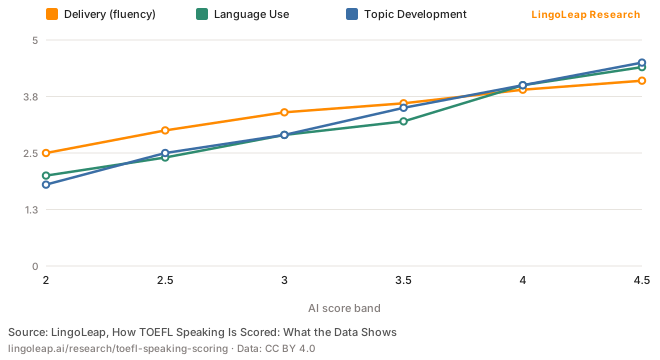
Worth noting is Topic Development: often assumed to be hard for a machine to measure, yet here elaboration and relevance are measurable and climb clearly with the score. High answers aren’t just well-delivered — they say more.
The chapters (one dimension at a time)
Chapter · Delivery
What separates the score bands: Delivery
Fluency, prosody, pace, length — and why ‘pause less’ is wrong.
What this study cannot show
- Dimension names borrow TOEFL’s public framework; the numbers are LingoLeap AI signals, not ETS scoring, and reproduce no rubric text.
- Observational, descriptive data: denominators and differences, no significance tests or causal claims.
- Scores are AI-assigned and may differ systematically from human rating; the three dimensions may also correlate with each other.
- Bands below 2.0 are excluded for short-answer artefacts.
Data
The aggregate tables behind this study, as CSV files.
- Every signal by AI score bandtoefl-speaking-by-score-band.csv
- Teacher handout (PDF)One page, A4 and Letter: three findings, a classroom drill and the method caveat.
Licence: Aggregate numbers only, under CC BY 4.0: reuse them with credit to LingoLeap and a link to this page. No learner answers, recordings or individual scores are published.
How to cite
APA 7
He, H. (2026, September 14). How TOEFL Speaking is scored: What the data shows (Version 1.0). LingoLeap. https://lingoleap.ai/research/toefl-speaking-scoring
MLA 9
He, Helen. “How TOEFL Speaking Is Scored: What the Data Shows.” LingoLeap, 14 Sept. 2026, lingoleap.ai/research/toefl-speaking-scoring.
Version 1.0 · Published 14 Sep 2026 · DOI: not yet assigned · Licence: CC BY 4.0
Questions we hear from learners
How is TOEFL Speaking scored?
The public scoring framework describes three dimensions — Delivery (how it sounds), Language Use (vocabulary and grammar), and Topic Development (relevance and elaboration). In LingoLeap's AI-scored practice data, average signals for all three are higher in higher score bands. These associations do not show that any one dimension causes or caps a score.
What are the three TOEFL Speaking scoring dimensions?
Delivery, Language Use, and Topic Development. Delivery is fluency, pace, prosody, and pronunciation; Language Use is vocabulary and grammar; Topic Development is relevance and how fully the answer is elaborated.
Which matters most for a high TOEFL Speaking score?
This descriptive dataset cannot rank their causal importance. Fluency shows the largest spread among the delivery signals reported here, while Topic Development and Language Use also increase across the AI score bands. The dimensions may be correlated with one another.
Are these official ETS scores?
No. These are LingoLeap's AI scores mapped to the three public dimension names, from real practice answers — not official ETS scores, and not a reproduction of ETS's rubric. They describe patterns in how answers are scored, useful for practice, not an official result.