Where Academic Discussion answers lose points: language, not ideas
The three rubric sub-scores of 3,683 AI-scored TOEFL Academic Discussion answers, side by side.
Helen He, CEO, LingoLeap · Published 26 Sep 2026 · 3,692 scored answers, retrieved 26 Sep 2026
The finding
Language Use & Grammar was the lowest sub-score, or tied for lowest, in 93.8% of answers.
Averaged over 3,683 answers, Relevance & Contribution scores 4.38 of 5, Clarity & Elaboration 3.88, and Language Use & Grammar 3.76. Language Use was strictly the lowest of the three in 30.6% of answers; Relevance was strictly the lowest in fewer than 30 answers (under 1%).
For a teacher, the one-line version: on this grader, an Academic Discussion answer is far more often held back by how it is written than by what it says.
Read this before quoting it
These are LingoLeap AI scores on published sample answers, not ETS scores and not all test-takers.
Every score here comes from LingoLeap's own rubric-trained AI grader, which reports an estimated 0–30 score and three 0–5 rubric sub-scores. Nothing here was scored by ETS, and nothing here tests how ETS's own scoring works. The answers are the sample answers LingoLeap publishes, which average 25.2 of 30: a stronger-than-typical group, so the spread of scores is narrow. The data is observational: it shows which answers score higher, not what would happen if you changed yours.
The pattern could come from the learners or from how LingoLeap's grader is calibrated; this data cannot tell which. It is a finding about these scores, not proof that grammar matters more than ideas on the real test.
The three sub-scores
LingoLeap's grader scores every Academic Discussion answer on the three dimensions of the published rubric, each out of 5. Ties are common because the scores move in half points: 63.7% of answers have two or three dimensions sharing the lowest score.
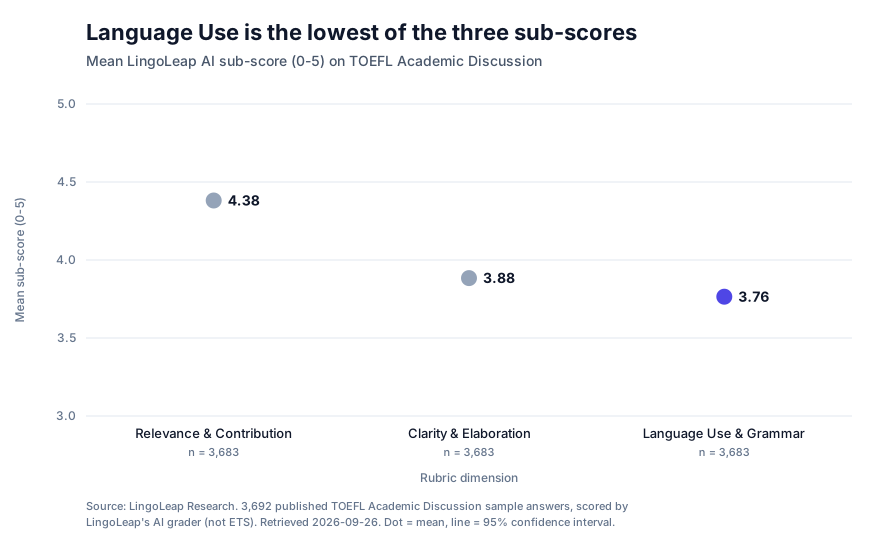
Embed this chart
Paste this HTML into your page. It is a static image with a credit link: no script, no iframe.
<figure style="margin:0;max-width:880px">
  <img src="https://lingoleap.ai/research/charts/academic-discussion-subscores.svg" alt="The three sub-scores" width="880" height="540" style="max-width:100%;height:auto" loading="lazy">
  <figcaption>Source: <a href="https://lingoleap.ai/research/academic-discussion-subscores">LingoLeap, Where TOEFL Academic Discussion Answers Lose Points: Data</a></figcaption>
</figure>
| Sub-score | Mean (0-5) | 95% CI | Strictly the lowest | Scored 5.0 |
|---|---|---|---|---|
| Relevance & Contribution | 4.38 | 4.37-4.40 | <30 answers | 11.1% |
| Clarity & Elaboration | 3.88 | 3.87-3.90 | 5.5% | <30 answers |
| Language Use & Grammar | 3.76 | 3.75-3.78 | 30.6% | <30 answers |
The remaining 63.7% of answers have a tie for the lowest sub-score. "<30 answers" marks a share resting on fewer than 30 answers, which is not reported.
By overall score band
Language Use has the lowest average in every overall score band (at the top, only 0.02 below Clarity), and it is also the dimension that climbs furthest: from 3.14 in the 22 or below band to 4.24 in the 28-30 band, a gain of 1.10 points, against 0.99 for Relevance and 1.01 for Clarity.
| Overall score (0-30) | Answers | Relevance | Clarity | Language Use | Language strictly lowest |
|---|---|---|---|---|---|
| 22 or below | 751 | 3.75 | 3.25 | 3.14 | 37% |
| 23-24 | 194 | 4.26 | 3.77 | 3.58 | 54% |
| 25-26 | 1,453 | 4.50 | 4.00 | 3.81 | 43% |
| 27 | 842 | 4.58 | 4.09 | 4.04 | 12% |
| 28-30 | 443 | 4.74 | 4.26 | 4.24 | <30 answers |
Bands with fewer than 30 answers are not shown; "<30 answers" marks a share resting on fewer than 30 answers.
The ceiling
11.1% of answers score a full 5.0 on Relevance. On Clarity and on Language Use, fewer than 30 of 3,683 answers (under 1%) do. Relevance is the only dimension on which this grader gives full marks with any regularity; on the other two, a 5.0 is almost never awarded to these answers.
Methodology
- Sample
- Every non-legacy TOEFL Academic Discussion task in LingoLeap's sample library, and the first 20 published sample answers for each: 3,729 sample pages. After exclusions, 3,692 answers across 1,467 tasks (mean score 25.17, SD 2.42; median length 154 words). These are real learner answers that LingoLeap publishes as samples, not every answer ever submitted.
- Period
- Retrieved 26 Sep 2026. The endpoint does not expose when an answer was written, so submission dates are not recorded.
- Source
- LingoLeap's public sample endpoint (the same data the sample pages show), read at no more than two requests a second: 3,723 of 3,729 pages returned a record.
- How scores were produced
- LingoLeap's AI estimate on the 0-30 scale and three rubric sub-scores on 0-5 (Relevance and Contribution to Discussion; Clarity and Elaboration of Viewpoint; Language Use and Grammar), parsed from the grader's report. Not ETS scores, and not on the 1-6 band scale ETS reports for tests from 21 January 2026.
- Exclusions
- 13 records with no answer text and 8 grader failures (overall 0 with every sub-score 0). Any group smaller than 30 answers is not reported.
- Limitations
- Observational: the pattern could come from the learners or from how LingoLeap's grader is calibrated, and this data cannot tell which. Published samples average 25.2 of 30, a stronger-than-typical group. LingoLeap AI scores, not ETS.
- Privacy
- Only aggregates are published. No answer text, names, or individual scores appear on this page or in the download.
- Lowest sub-score
- For each answer with all three sub-scores (3,683), the dimension with the lowest score is recorded; if two or three share it, the answer counts as a tie. "Lowest or tied" counts every answer where Language Use is at the minimum, alone or shared.
Reproduce it
Every figure on this page is produced by scripts/academic-discussion-findings.py in LingoLeap's website repository, which re-reads the public sample pages and reprints each number. The aggregate table is in the Data section below (CC BY 4.0).
What this does not show
- 1
Not ETS
These are LingoLeap AI sub-scores on the published rubric's three dimensions. ETS's human raters and e-rater may weight the dimensions differently.
- 2
Learners or grader?
A grader that is stricter on language than on content would produce the same table. This study cannot separate the two.
- 3
Not every learner
The answers are LingoLeap's published samples, which average 25.2 of 30. Weaker answers, which may fail on relevance too, are under-represented.
- 4
No submission dates
The public sample data does not say when each answer was written, so the study has a retrieval date, not a date range.
Data
The aggregate tables behind this study, as CSV files.
- Sub-scores by overall score bandacademic-discussion-subscores.csv
- Teacher handout (PDF)One page, A4 and Letter: three findings, a classroom drill and the method caveat.
Licence: Aggregate numbers only, under CC BY 4.0: reuse them with credit to LingoLeap and a link to this page. No learner answers, recordings or individual scores are published.
How to cite
APA 7
He, H. (2026, September 26). Where TOEFL Academic Discussion answers lose points: Data (Version 1.0). LingoLeap. https://lingoleap.ai/research/academic-discussion-subscores
MLA 9
He, Helen. “Where TOEFL Academic Discussion Answers Lose Points: Data.” LingoLeap, 26 Sept. 2026, lingoleap.ai/research/academic-discussion-subscores.
Version 1.0 · Published 26 Sep 2026 · DOI: not yet assigned · Licence: CC BY 4.0
FAQ
Which part of the Academic Discussion rubric do learners score lowest on?
Does that mean learners should study grammar instead of ideas?
Is this how ETS scores the test?
Can I reuse the data?
See your own three sub-scores
Write an Academic Discussion answer and get Relevance, Clarity and Language Use scored separately.
Practise Academic Discussion